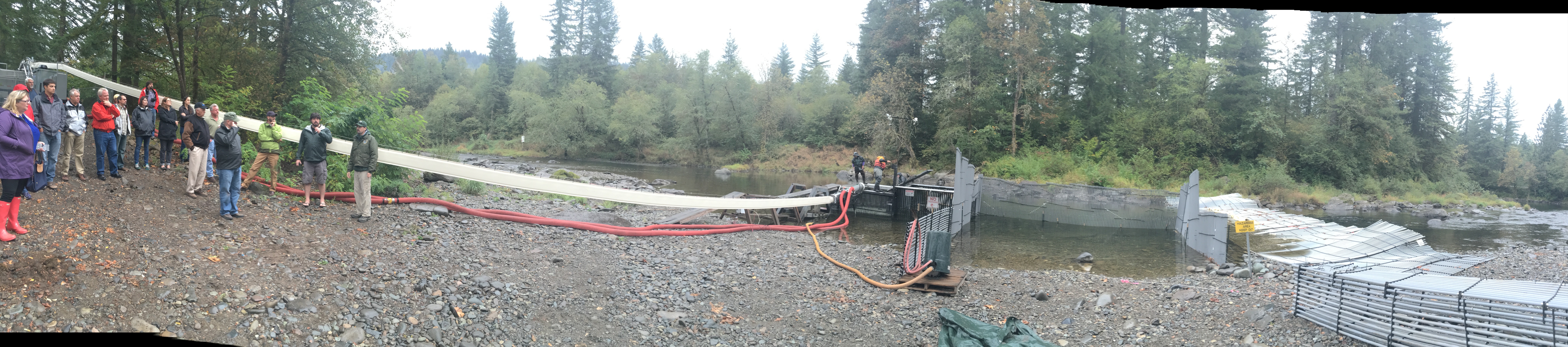
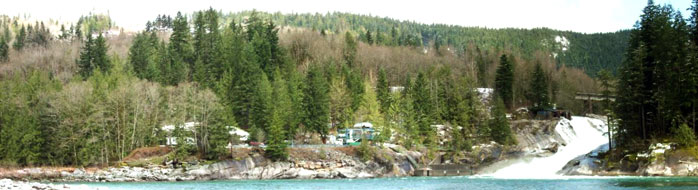
Last month, attorney Sarah Liljefelt organized a tour of the Whooshh Innovations fish passage structure constructed for the Washington Department of Fish and Wildlife on the Washougal River. Members of the Oregon State Bar Environmental and Natural Resources Section attended, including attorneys in private practice, working for the State of Oregon, and public interest.
Whooshh has patented new technology that propels fish through a rubber tube fish canon from one location to another in mere seconds, be the end result a truck to haul fish, or to the other side of a dam as a new type of fish passage. Studies have shown that stress on the fish is lesser in the Whooshh system than traditional fish passage, and the cost is only a fraction of renovating a dam for traditional fish passage.
Check out videos of the Whooshh system (and fish flying through the system) at Whooshh’s website: http://www.whooshh.com/.
Stay tuned to Schroeder Law Offices’ Water Law Blog for more news!
How Safe is Your Drinking Water?
With the recent discoveries of lead in Portland Public Schools drinking water and the September 15th discovery at the University of Oregon, it becomes a reminder for us all to ensure that our groundwater supply is providing healthy and safe drinking water.
According to the Oregon Health Authority, 90 percent of the population of the state draws all or part of their water supply from groundwater, which amounts to about one billion gallons of groundwater every day. Approximately 23 percent of Oregonians use domestic or private wells as their main source of water. For these well owners it is especially important to watch out for common types of contamination that might affect their water supply. These types of contamination include:
Improper storage or disposal of hazardous substances
Improper use of fertilizers, animal manures, herbicides, insecticides, and pesticides
Improperly abandoned wells (these include water wells, groundwater monitoring wells, and wells used in cleaning contaminated groundwater)
Poorly sited or constructed water wells
The Portland Water Bureau is currently working to finish a study looking at the issues of lead in Portland’s drinking water, but major changes won’t be possible until 2022. Private well owners can begin taking steps to protect their groundwater today by being more mindful of how they care for their wells and dispose of hazardous materials.
More information on how to keep your well clean and safe can be found by visiting the National Groundwater Association website.
REMINDER-2016 Year End Reporting to Oregon Water Resources Department for Oregon Water Rights and Uses
It’s getting close to that time of year again! As the 2016 irrigation season comes to a close, we here at Schroeder Law Offices want to remind you of the December deadlines to report measurements for your water uses to Water Resources Department (“OWRD”).
There are two different reporting deadlines to be aware of in December. The first applies to ground water uses in either the Stage Gulch or Butter Creek Critical Ground Water Areas (“CGWA”). Ground water users in these CGWA are required to report flow meter and/or power readings to OWRD by December 1st each year. The photo below shows OWRD’s designation of various ground water areas.
More information about requirements for ground water use in the Stage Gulch or Butter Creek CGWA is contained in Oregon Administrative Rules 690-507-0610 to 690-507-0830. http://arcweb.sos.state.or.us/pages/rules/oars_600/oar_690/690_507.html. To obtain the required reporting form contact OWRD’s ground water section.
The second December reporting deadline is a permit or certificate specific requirement and applies to both ground water and surface water rights. If your paper water right permit or water right certificate requires annual reporting it will include language along these lines:
You are also required to keep a complete record of the amount of water used each month and submit a report that includes the recorded water use measurements to OWRD annually, or more frequently if required by the Director. Further, the Director may require you to report general water use information, including the place and nature of use of water under the permit.
Your annual water use report is due to OWRD by December 31 each year.
As you will note, the reporting period is based on the “water year” rather than the calendar year. OWRD considers the “water year” October through September annually, as outlined in the enclosed form.
We encourage you to take meter readings at the end of each month and keep these readings in your own files along with a copy of the report that you submit to OWRD.
Stay tuned to the blog throughout the year for more helpful water use related reporting deadlines.
Next Generation Farmers Need Our Help
New studies have shown that a large number of older farmers are concerned with their ability to find a successor who is able to afford to buy their land, thus putting their plans for retirement at risk. Currently, the average age of the American farmer is 58 years old. Only less than 6% of American farmers are 35 years old or younger. With the vast majority of farmers nearing the average American retirement age, it is not surprising that over 60% of farmland is ready to be passed onto the next generation of farmers.
The problem is that the younger generation of farmers is losing the battle of being able to afford the land. According to a recent study by American Farmland Trust (”AFT”), land values are set too high for prospective landowners. This puts the land at risk while the banks, equity firms, and larger corporate farms take advantage of these opportunities to snatch up the land that the younger farmers cannot afford. A recent report by the U.S. Department of Agriculture (“USDA”) has shown that 2 of the biggest hurdles faced by the next generation of farmers are accessing credit for, and finding affordable farmland. Being bought out by larger corporations, or even just the threat of the possibility, along with stress of qualifying for a loan and finding affordable land, has led to a large number of younger farmers leaving the farming industry.
How Can You Help?
So, how do we help? The USDA and the AFT are working on programs to assist beginning farmers and ranchers enter the field and help pay farmers for the development rights to their land. But there are ways we all can help. Some examples include: buying direct, purchasing produce from farmers’ markets, or joining community supported agriculture programs. For more information, please see http://civileats.com/2016/08/05/digested-farm-together-now/
Schroeder Law Offices Welcomes Lindsay Thane to the Team!
Lindsay Thane
Schroeder Law Offices is happy to announce the newest addition the team, Lindsay Thane! Lindsay Thane has accepted the position as JD Paralegal in the Portland, OR office. Lindsay comes to Schroeder Law Offices from Montana where she received her J.D. from the University Of Montana School Of Law with a certificate in Natural Resource & Environmental Law. Prior to Law School, Lindsay earned her B.A. degree in Political Science from the University of Oregon. Lindsay has taken the Oregon State Bar exam and is currently awaiting the results with high hopes.
Lindsay brings a wide array of experience to Schroeder Law Offices including legal research, writing, and even judicial clinic experience. Through her experience, Lindsay has spent valuable time in the natural resources field including positions with the U.S. Department of the Interior as well as the U.S. Environmental Protection agency.
We are looking forward to working with Lindsay!
Other Employment
Schroeder Law Office is currently looking for the right attorney to fill a vacancy in the Reno, NV office. For more information regarding this position and how to apply, visit our website at: http://www.water-law.com/reno-attorney/
Rights-of Way on Public Lands and Administrative Avoidance
Century old rights-of-way uses of public lands can only be confirmed through a long, expensive federal court process. Because the Bureau of Land Management (BLM) and U.S. Forest Service (USFS) cannot determine the validity of water delivery and road rights-of-way on public lands, farmers, ranchers, and local governments may face an uphill battle to legally confirm and adjudicate these long-standing uses.
Revised Statutes (RS) 2477 and 2339 were components of the Mining Law of 1866, also called H.R. 365. This Act recognized the activities of settlers and miners occupying the West and encourage development of federal lands.
RS 2477 recognized roads and highways on public lands not already withdrawn from entry. RS 2339 protects the use of water infrastructure used for mining, agriculture, manufacture, and other purposes in place prior to the lands being withdrawn as well. These road and ditch laws honored development protocols and uses based on the local custom and laws at the time of early settlement.
While these laws are no longer in effect with the passage of the Federal Land Policy and Management Act (FLPMA), these self-granting rights-of-ways created while the law was in effect have not disappeared. FLPMA recognizes existing rights on public lands prior to its passage. See: http://www.blm.gov/ca/dir/pdfs/2003/ib/CAIB2003-023ATT2.pdf
Make sure to stay tuned to Schroeder Law Offices’ Water Blog for more news that may affect you!
This article was drafted with the assistance of Law Clerk Jakob Wiley, a concurrent student at Oregon State University’s Water Resources Policy and Management graduate program and a law student at the University of Oregon School of Law.
New: Harney Valley Groundwater Area of Concern
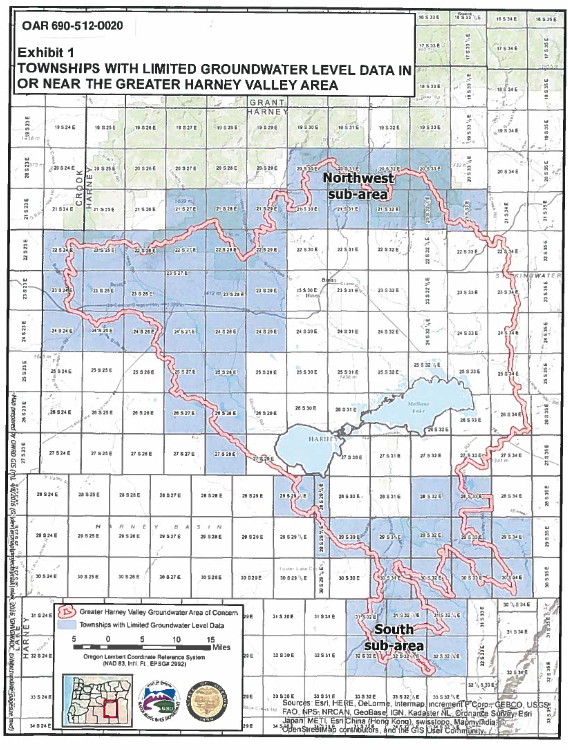
Greater Harney County Groundwater Area of Concern
The Oregon Water Resources Commission’s (OWRC’s) rulemaking for the Greater Harney Valley Groundwater Area of Concern (Area of Concern) became effective on April 15, 2016. The new regulations limit pending and new applications for groundwater use in the Malheur Basin. Citing concern over lowering groundwater levels in the region, OWRC passed the new regulations to limit new water development until the Oregon Water Resources Department (OWRD) can adequately study the basin’s groundwater. This regulation is a component of the Malheur Basin Program. The drafts, maps, and rules are available at: http://www.oregon.gov/owrd/Pages/law/Department_Rulemaking.aspx.
Over a year ago, OWRD stopped issuing new ground water permits within the Area of Concern. Until the most recent rulemaking, however, no rules were in place allowing OWRD to halt permit processing and issuance. Usually, OWRC will create by rule Critical Groundwater Areas, Groundwater Limited Areas, and Serious Water Management Problem Areas prior to OWRD ceasing to issue new permits.
OWRC can designate Critical Groundwater Areas for multiple reasons, including declining groundwater levels, substantial interference between wells, overdraft of groundwater, or water quality degradation. OWRD must indicate the boundaries of the area and review the designation at least every 10 years. The designation allows OWRD to, for example, close the area to any further appropriation, limit the total withdrawal from the aquifer, and refuse applications for new groundwater permits.
Groundwater Limited Areas limit future appropriations of water to specified uses, but do not restrict existing consumption of water within the area. Serious Water Management Problem Areas allow OWRD to collect usage data from current water use right holders, but not restrict water consumption. These tools are used to collect information and guide future development of water resources in Oregon.
Rather than designating a critical or limited groundwater area, or a serious water management problem area, OWRD addressed the Harney Valley Groundwater Area of Concern by amending the Malheur Basin Program. Basin programs are used by OWRC to guide water right permitting decisions and coordinate with other state agencies. Within basin plans, OWRC may classify the highest and best uses for particular basins and waterways for future uses, including proscribing types of uses available to future applicants. Oregon’s basin programs are listed in the Oregon Administrative Rules Chapter 690, beginning at Division 500, and the Malheur Basin Program is located at Division 510, available at: http://arcweb.sos.state.or.us/pages/rules/oars_600/oar_690/690_510.html.
The new regulations for the Greater Harney Valley Groundwater Area of Concern propose to both limit future uses and collect information before OWRD completes a full study of the aquifer, expected to be completed by 2020. The proposed rules received 22 comments, which can be viewed at: http://apps.wrd.state.or.us/apps/misc/vault/vault.aspx?Type=WrdNotice¬ice_item_id=6640. In the meantime, 39 groundwater use applications are pending before OWRD, and these applications will not be approved, unless they meet conditions included in the new basin plan regulations. This is in direct opposition to the rule that applications must be processed based on the laws and regulations in effect at the time of filing, but OWRD is taking the position that groundwater is not available for the applications, rather than a regulatory change affected the outcome of the applications (this is not a new approach from OWRD).
The “area of concern” is, in effect, a moratorium on new groundwater development in the region. The new regulations create restrictions on new applications reminiscent of critical groundwater areas, but within the basin program scheme. The moratorium will put a halt to development in the region, at least while OWRD studies the groundwater in the area. Locals familiar with groundwater in the Malheur Basin are resentful of OWRD’s blanket moratorium when certain areas within the basin do not appear to show the same level of strain as others, and continue to produce great quantities of groundwater.
Make sure to stay tuned to Schroeder Law Offices’ Water Blog for more news that may affect you!
This article was drafted with the assistance of Law Clerk Jakob Wiley, a concurrent student at Oregon State University’s Water Resources Policy and Management graduate program and a law student at the University of Oregon School of Law.
Update: Klamath Basin Agreements in 2016
On April 6, 2016, amendments to the Klamath Hydroelectric Settlement Agreement (KHSA) and the new Klamath Power and Facilities Agreement (KPFA) were signed at a ceremony at the mouth of the Klamath River on the Yurok Indian Reservation. These changes come in the wake of the Congress’s decision not to pass legislation for the Klamath Basin Restoration Agreement (KBRA). Negotiations between the signatories of the new agreements in the Klamath Basin were kept secret, the results of their discussions can be seen in these new agreements, available at: https://www.oregon.gov/owrd/Pages/adj/index.aspx.
The amended KHSA’s purpose is to establish a process for removal of Iron Gate, Copco 1, Copco 2 and J.C. Boyle dams under the Federal Energy Regulatory Commissions relicensing procedures. The decision to remove the dams was made based on a cost-benefit analysis that was not released to the public. The amended agreement will also shield PacificCorp and its customers from liability for damages associated with dam removal. The amended agreement transfers the ownership of the dams to the Klamath River Renewal Corporation. The new corporation will conduct the dam removal, while PacificCorp will operate the dams until their decommissioning. The dams are expected to be removed in 2020. The U.S. Department of the Interior, the U.S. Department of Commerce, California and Oregon States, and PacificCorp were parties to the agreement.
The KPFA is an agreement designed to mitigate economic and regulatory issues facing users of water and land in the Klamath Basin. Oregon and California States, the Klamath Water Users Association, public interest groups (including American Rivers, Trout Unlimited, and Sustainable Northwest), the U.S. Department of the Interior, and the National Marine Fisheries Service were parties to the agreement. The KPFA stipulates that the signing parties must meet and confer when there is an unforeseen circumstance related to the fishery restoration and regulatory impacts on the local economy. It also obligates the U.S. Bureau of Reclamation (“BOR”), upon transfer of the operation of Link River and Keno Dams, to operate the dams without adding any associated costs to water users for the maintenance of infrastructure. The BOR will operate those dams consistent with existing contracts for irrigation and flood control, and attempt to prevent salmon from entering irrigation canals and ditches. Funding for projects preventing salmon entry into irrigation infrastructure will come from a variety of sources, including irrigation districts, federal, state, and private parties. The agreement also requires the signing parties to support and defend the KHSA, refrain from making statements in opposition to the KHSA, and support the KHSA in administrative and judicial forums. Notably, representatives of the local landowners that will be affected were not included in negotiations, and are not signatories to the agreement.
In short, after many years of receiving a clear message from Congress that it was not going to fund the KBRA’s dam removal plan, the proponents are moving forward without Congress’s approval, or the approval of the local residents that will be most affected. Rather than retrofit the dams to allow fish passage and other updates, the negotiating parties are removing the dams. Along with the dams, the negotiating parties are doing away with inexpensive power, jobs, and water storage for increased reliability within the basin, in a proverbial “flushing the baby with the bathwater” situation. It remains to be seen how severe the impacts from dam removal will be on top of the other stresses that the Klamath Basin has suffered since the administrative phase of the Klamath Basin Adjudication was completed, and since the region has suffered from severe drought for several years.
Make sure to stay tuned to Schroeder Law Offices’ Water Blog for more news that may affect you!
This article was drafted with the assistance of Law Clerk Jakob Wiley, a concurrent student at Oregon State University’s Water Resources Policy and Management graduate program and a law student at the University of Oregon School of Law.
New Oregon Water Permit Condition to Begin Construction
The Oregon Water Code provides that construction of a water system must be completed within certain time limits from issuance of water use permits (5 years for non-municipal water use permits, and 20 years for municipal permits). ORS 537.230 (“…the holder of a water right permit shall prosecute the construction of any proposed irrigation or other work with reasonable diligence and complete the construction within a reasonable time, as fixed in the permit…”); ORS 537.630. The same provisions allow the Oregon Water Resources Department (“the Department”) to grant extensions of time for completion of construction.
The Oregon Water Code also provides that water use permits may be cancelled when a permittee fails to begin construction within permit deadlines. ORS 537.410(1) (“Whenever the owner of a permit to appropriate the public waters of Oregon fails to commence actual construction work within the time required by law, or having commenced construction work as required by law, fails or neglects to prosecute the construction work with reasonable diligence, or fails to complete the construction work within the time required by law, or as fixed in the permit, or within such further time as may be allowed under ORS 537.230, or having completed construction work, fails or neglects to apply the water to beneficial use within the time fixed in the permit, the Water Resources Commission may cancel the permit on the records in the Water Resources Department as provided in ORS 537.410 to 537.450.”)
In determining whether to grant an extension of time, the Department considers: 1) the cost of the appropriation and application of water to a beneficial purpose, 2) the good faith of the appropriator, 3) the market for water or power to be supplied, 4) the present demand for the water or power to be supplied, and 5) the income or use that may be required to provide fair and reasonable returns upon the investment. ORS 537.230(3); ORS 539.010(5); see also OAR Chapter 690 Division 315. The Department’s general practice has been to liberally grant extensions of time if the permittee is able to show a financial investment to begin construction and/or water use under the permit and a reasonable explanation for the delay. Permit extension of time applications are available on the Department’s website at: http://www.oregon.gov/owrd/PUBS/docs/forms/App_Ext_WR_perm.docx.
Recently, the Department has added the following condition to new permits: “The deadline to begin construction may not be extended.” Although the new permit condition does not mark a departure from the Oregon Water Code’s provisions, it does mark increased seriousness from the Department about what is necessary to obtain an extension of time to develop a new water use right. Permittees should be sensitive to the change in climate regarding beginning construction and applying water to beneficial use.
Now, more than ever, it will be important to begin construction within the 5-year deadline in order to avoid permit cancellation. “Actual construction” means “physical work performed towards completion of the water system, which demonstrates both the present good faith of the water right permit holder and the water right permit holder’s intention to complete the project with reasonable diligence.” OAR 690-315-0020(3)(d)(A). This does not include planning, securing financing, entering into contracts, surveying, or purchasing (but not installing) equipment. OAR 690-315-0020(3)(d)(B).
Make sure to stay tuned to Schroeder Law Offices’ Water Blog for more news that may affect you!
Oregon water conservation projects receive $8.9 million in funding
The Oregon Water Resources Commission recently awarded nine water supply project proposals in the state of Oregon with a combined $8.9 million for projects focusing mainly on water conservation.
The Commission received funding in the amount of $14 million from the state to implement large-scale water conservation plans across the state. Although urged to fund as many projects as possible with the money, the Commission awarded grants to the nine Oregon Water Resources Department recommended projects.
Oregon is doing its part to conserve water on a large-scale.
Does your Oregon water well have a Well Identification Number? Should it?
Many Oregonians use water wells on their properties. Since the 1960s, well drillers have been statutorily required to submit well logs to Oregon Water Resources Department (“OWRD”) for each water well they drill or modify. Well drillers are also statutorily required to record identification numbers on any water wells drilled, deepened, converted, or altered since 1996 within 30 days after completion of the construction.
Additionally, if a property with an unidentified water well is sold, the owner of the property is statutorily required to record an identification number obtained from OWRD on the water well within 30 days of the sale. This photo from the state’s Water Well Handbook shows an example of a water well with an identification number recorded on it. To apply to OWRD for an identification number for a water well on your recently purchased or sold property click here.
Property purchases are complicated! Here at Schroeder Law Offices, we find that many people who purchase or sell a property with a water well or water use rights overlook important housekeeping matters unique to water wells and water rights. Stay tuned to our blog for more helpful tips.
101 on Forfeiture vs. Abandonment Under Prior Appropriation Doctrine
Forfeiture
We’ve all heard “Use it or Lose it” referring to the Prior Appropriation System. The use it or lose it concept is the term we use for legal forfeiture which will apply to your water rights of use depending on your jurisdiction and type of water right. Generally, this concept requires beneficial use of water appropriated under state law over a specific time interval. In some states (like Nevada and Oregon), “use it or lose” is statutorily controlled, the law describes when a water user must exercise their water right of use. In Oregon both groundwater and surface water certificates require water use once for every five consecutive year time frame. ORS 540.610. In Nevada, the statute provides that only groundwater certificated uses are subject to forfeiture for non-use if not used at least once every five years. NRS 534.090. Thus, if you last used your certificated water right of use in 2011, you best put whatever water is available for appropriation under your certificate in place for 2016! Make sure to use it so you are not at risk of losing it!
Abandonment
Use it or lose it as defined by the water code should not be confused with abandonment, a court made doctrine that may be more broadly applied. Abandonment will cause cancellation of a water use by intention not to use. Intention can be established by expression as in a written document or by a physical act. The physical act of abandonment can include placing a permanent structure over or on top of water righted lands. If you plan to build the next industrial sized plant, packing shed, scale house, onion storage, fill in your ditch, or take out your diversion structures, etc., you should file that water use transfer or change application prior to any construction!
While this gives you the very “basic” overview of these two legal concepts, Schroeder Law Offices can provide a more detailed explanation
Sage Grouse Workshop
BLM’s Sage Grouse Plan Collaboration-Implementation is underway.
As part of the BLM’s effort to ensure collaboration and engagement during implementation of the sage grouse plans, the BLM is sending out invitations to stakeholders to begin the dialogue.
These invitation only meetings will occur on:
April 22nd in Salt Lake City, UT
April 26th in Boise, ID
April 27th in Reno, NV
April 28th in Redmond, OR
You are requested to RSVP at the link below to reserve your spot by April 15, 2016, so that we can set up the workshop for the appropriate number of participants:
While space is limited for these invite-only dialogues, BLM plans to conduct additional public meetings later this spring and summer. Once these public meetings are scheduled, information will be available on: http://www.blm.gov/id/st/en/prog/wildlife_and_fisheries/greater_sage-grouse.html. If you are interested in receiving an invitation to these meetings, please contact your state BLM office.
Renewable Energy Demand Grows; Hydro Power Faces Challenges, Opportunities
In the Northwest, a substantial percentage of our power comes from hydroelectric projects. California’s new legislation requires utilities to provide electricity from 50% renewables by 2030, and Oregon’s new legislation requires the same by 2040. The hydro power industry is viewing these renewable standards as creating continuing demand for hydro power, but several trends are creating serious hurdles for the hydro power industry.
More large projects are going through FERC re-licensing than those large projects that would seek first-time licenses. The result is that older projects are becoming subject to new instream flow and fish passage requirements. The older projects going through re-licensing are usually required to make facility upgrades, and regulate the projects to send more water downstream.
Additionally, climate change means that water patterns are also changing. Scientists predict that more precipitation will fall during the winter, with less flows from snow pack runoff and precipitation in the spring and summer. Predicted changes will create a large burden on facilities that provide flood control, possibly exceeding the amounts of water the facilities were designed to withstand. Further, flows released to meet instream flow requirements in the spring could mean that water is not available for power production and water users later in the season when there is a larger demand.
Moreover, new in-stream storage projects often meet substantial opposition from environmental groups. Therefore, some innovative hydroelectric developers are constructing out-of-stream projects. For example, the Snohomish Public Utility District in Washington is reviewing an opportunity to construct the Sunset Fish Passage and Energy Project, http://www.snopud.com/?p=1956. An underwater intake structure would divert water from the South Fork Skykomish River, and would flow one-half mile through an underground tunnel to the PUD powerhouse, thereafter emptying back into the river. The PUD would also update the Washington State Department of Fish & Wildlife’s trap-and-haul facility as part of the project. In this way, the PUD proposes an innovative way to create hydro power while satisfying those who are typically opposed to new projects.
Schroeder Law Offices is assisting a client to develop a closed-loop hydro power project using existing agricultural groundwater use rights. It is the first of its kind in Oregon, and will not have undesired effects on surface water streams or fish passage. These types of innovative hydro power designs will need to be used more and more if hydro power is to keep a foothold in renewable energy portfolios in the West.
Stay tuned to Schroeder Law Offices, PC’s Water Law Blog for water news that could affect you!
Announcing Sarah Liljefelt as Junior Partner!
Schroeder Law Offices is proud to announce Portland’s Managing Attorney, Sarah Liljefelt, has been promoted to Junior Partner. Sarah has been with the firm since 2009 as a law clerk, and joined the firm full time after receiving her Juris Doctorate and Certificate in Environmental and Natural Resources Law from Northwestern School of Law of Lewis and Clark College in 2010.
Sarah’s practice focuses in the areas of water rights, real property law, and litigation, licensed in both Oregon and California. As a member of the Oregon State Bar Environmental and Natural Resources Law Executive Committee, Sarah has published extensively on natural resources law and related topics.
In addition to her focused practice areas, Sarah is active in the Portland community. She is currently a Vice President of Oregon Cattle Women, and competes on the Oregon Women Lawyer’s “Dragonflies” dragon boat team.
Sarah was born and raised in California during a time of serious drought and is passionate about the importance of water resources for people, animals, and the production of food in the face of supply variations.
California’s New Water Measuring, Recording & Reporting Law
California Governor Brown signed Senate Bill 88 into law on June 24, 2015. Part of that Bill amended the California Water Code to require that all persons who divert 10 acre-feet or more of water per year after January 1, 2016 must install a water measuring device to measure the rate of diversion (including diversion into and out of storage). Water users must report installation to the Water Board, as well as provide evidence that the measuring device is functioning properly at five-year intervals. Water users must maintain records of diversion at time intervals of one hour or less (in some cases) and total amounts of water diverted.
Annual diversion reports must be submitted to the Water Board, and the law states: “Compliance with the applicable requirements of this section is a condition of every registration, permit, or license.” The new law imposes civil fines in an amount not to exceed $500 per violation, per day, which may be enforced civilly through the superior court, or administratively by the Water Board. The Water Board will provide forms for reporting.
On January 19, 2016, the Water Board adopted emergency regulations to implement the new water measuring law. Those regulations were sent to the Office of Administrative Law for approval. Of note, the proposed regulations give the Deputy Director of the Division of Water Rights the authority to require monthly, daily, or more frequent reporting in times when there are insufficient flows to support all diversions. Additionally, the regulations propose a phased approach that takes into account the amount of water diverted, with larger diverters needing to comply with more stringent requirements than smaller diverters.
The recent drought spurred California law makers to enact this law that will mark a drastic change in the way water users operate. The Water Board reports that this new measurement, recordkeeping, and reporting law will apply to approximately 12,000 water users in California. The Water Board hopes that the new law and regulations will improve water use regulation and planning. Industry groups, including the California Cattlemen’s Association, oppose the regulations.
In Oregon, the Water Resources Department has phased in water use measuring, recordkeeping, and reporting requirements into new water use permits that are issued. California’s new law and regulations impose a new condition on existing water use rights, raising red flags about regulatory takings.
Stay tuned to Schroeder Law Offices’ Water Blog for more news that may affect you!
Forest Service Changes It’s Tune on Transfer of Ski Area Water Rights
Final rulemaking related to Forest Service permits for Ski Area Water Rights was released on December 30, 2015. Unlike an earlier directive passed in 2011, the Ski Area Water Clause will not require ski areas to transfer water rights to the federal government as a condition of operating on public land. Instead, the new clause will require ski areas to prove there is a “sufficient quantity of water to operate a ski area.” The new directive will take effect on January 29, 2016.
In 2011, sparked by the concerns that ski areas might sell their water rights in lieu of using them to operate due to rising temperatures and water scarcity, the Forest Service issued a directive that would require joint ownership of water rights by ski areas and the United States. Since water rights are typically held by the lessee, this directive would have required a transfer of rights into shared ownership in some instances, and for water rights to be acquired in the name of the United States in others. The National Ski Area Association (NSAA) brought suit against the Forest Service challenging the directive on January 9, 2012, characterizing the directive as government overreach. In December, 2012 a federal judge agreed with the NSAA and ordered the Forest Service not to enforce the proposed rule.
The December 30th directive abandons the original proposal that ski areas transfer water rights to the federal government. Instead, after an extensive public comment period, the final directive requires an applicant for a ski area permit to submit documentation prepared by a hydrologist that demonstrates there is sufficient water to operate a ski area for the entirety of the ski area permit term. The final directive explains that “sufficient water to operate a ski area” means that under typical conditions, taking into account fluctuations in utilization of the authorized improvements, fluctuations in weather and climate, changes in technology, and other factors deemed appropriate by the applicant’s qualified hydrologist of licensed engineer, the applicant has sufficient rights or access to a sufficient quantity of water to operate the permitted facilities, and to provide for the associated activities to be authorized under the ski area permit in accordance with proposed operating plan.
Additionally, if there is a change such as a change in ownership, and a ski area water facility will not be primarily used for operating a ski area, the authorization for the facility under the ski area permit will be terminated and the facility must be removed from National Forest Service lands. Lastly, if a ski area permit is terminated or revoked, the holder must give a right of first refusal of the water rights associated with the permit to the succeeding ski area permit holder. If the water use right is jointly owned with the United States, the holder must give a right of first refusal to the government.
The stated goal of this new rule is to promote the long-term sustainability of ski areas on National Forest Service lands and the communities that depend on the ski areas for revenue. There are 122 ski areas that lease approximately 180,000 acres of lands managed by the Forest Service. Ski areas received about 23 million visitors annually, contributing $3 billion to local economies and supporting approximately 64,000 full and part-time jobs in rural communities. In the West, water use rights for many ski areas are business assets, property interests that operate as collateral when re-financing. One major criticism of the original rule, was that requiring water rights to be co-owned by the federal government would limit a ski area’s ability to control their assets and thus their ability to finance operations.
Thus, the directive ensures that ski areas not only have adequate water supply for operating, but that infrastructure to handle the water supply is used only for permitted purposes under the special use permit. Hailed as a success by both the Forest Service and the ski industry, these actions demonstrate a coordinated effort to eliminate the risk of sales or transfer of water rights that might prevent a ski area from operating in the future and ensure that water will remain available for ski areas across the West.
Hammond Protest builds Militia Momentum
If you don’t know the Hammond family of Harney County, Oregon, you will soon. As the Hammond protest builds momentum backed by a voluntary militia, Dwight Hammond, 73, and his son, Steven Hammond, 46, are making headlines again. Three years ago, the pair made headlines when convicted in Federal Court of arson for fires lit on the Hammond Ranch in 2001 and 2006 to reduce the growth of invasive plants and protect their property from wildfires. Convicted under an anti-terrorism act, Dwight Hammond served three months’ time for the conviction while his son Steven served a full year.
As the Federal Judge suspended the minimum sentence under the guidelines as “shock[ing] the conscience,” the U.S. Attorney appealed the sentence to the Ninth Circuit who ruled that both are due to return to prison to serve the federal prison terms of five years. Private landowners often find themselves at the mercy of the federal government as large parts of the West Coast are in government hands, the story of the Hammond’s conviction and resentencing may be all too familiar to private ranchers in the area who have already felt the pressures of forced sales.
Though the Hammonds have planned to report to prison today, January 4, 2016, as ordered, riled up liberty supporters from surrounding states have a different disposition. Ammon Bundy, son of Nevada rancher Cliven Bundy whom was involved in a standoff with the government and Bureau of Land Management (BLM) in 2014 over grazing rights, has joined with a growing band of armed militiamen acting as organized sympathizers to the Hammonds. Though the Hammonds have no direct involvement with the militia, Bundy and others valiantly stake support claims that the Hammonds should not be tried as terrorists and have rights to the tried actions per purchase rights and federal grazing allotments. The Hammonds have and will continue respecting the rule of law and follow court orders without incident or violation. Click here to view their statement.
The Hammond family’s farm has been eyed by US Fish and Wildlife Service (FWS) and BLM since the 1970s when ranches adjacent to the Hammonds and others were sold and added to the Malheur National Wildlife Refuge. Though approached by FWS and BLM many times, the Hammonds (as well as other ranchers) refused to sell. While many ranchers in the area were forced to leave, another 32 out of 53 permits were revoked, and grazing fees were raised significantly for those who remained in the area. By the 1990s, the Hammonds were one of very few ranchers that were still private owners of property adjacent to the Malheur National Wildlife Refuge. The four year resentencing request for Dwight and Steven Hammond comes from an appeal filed by the BLM Field Manager and Refuge Manager for the Malheur Refuge.
The Hammonds attorneys report that “the Hammonds will continue their legal efforts to renew their grazing permits. They will also pursue Executive Clemency. We hope that President Obama will agree with us and with the veteran judge who presided over the trial that the mandatory five-year minimum sentence is far too long for these ranchers.”
Congress has adjourned for the year without passing a bill to authorize and fund the Klamath Agreements. The Klamath Basin agreements include: the Klamath Hydroelectric Settlement Agreement (“KHSA”), Klamath Basin Restoration Agreement (“KBRA”) and Upper Klamath Basin Comprehensive Agreement (“UKBCA”) that together lay out a comprehensive scheme for changes in management along the entire reach of the Klamath River. After years of litigation and negotiation, certain stakeholder groups came together to craft the trio of agreements. However, the agreements did not sit well with everyone. Particularly those in Klamath County and their California neighbors due primarily to the highly controversial dam removal provisions and drying up thousands of acres of farmland. For these among other reasons, the agreements, which required authorizing legislation and funding from Congress, failed to gain traction.
Senator Ron Wyden [D-OR] attempted multiple times to pass the necessary legislation to authorize the agreements. The latest version, the Klamath Basin Water Recovery and Economic Restoration Act of 2015, has been stalled in committee since last January (2015). In an effort to move forward, on December 3, 2015, Representative Greg Walden [R-OR] released a draft bill intended to “help provide water and power certainty for agriculture and boost economic development and job creation for rural communities and tribes through a transfer of federal timber lands.” Walden’s draft bill omitted dam removal and authorized transferring up to 100,000 acres each of National Forest land to Klamath County, OR, and Siskiyou County, CA. These issues quickly became non-starters for the Tribes who held the “ears” of Senators Wyden and Merkley.
The KHSA is set to expire on January 1, 2016. While the parties can vote to extend it, some signatories are beginning to question if the agreements provide workable solutions for the Klamath basin. The Yurok Tribe clearly communicated its intent to terminate the agreement. Similarly, the Klamath Tribal Council has issued a dispute notice. Additionally, PacifiCorp, the company that owns the dams, has changed course and now indicates it will pursue re-licensing of the dams. Thus, many parties that initially favored the agreements are beginning to show their discontent. This may have been another reason authorizing legislation had difficulty making its ways through Congress.
In March of 2015, The Oregon Water Resources Department passed administrative rules, Oregon Administrative Rules 690-025, to help govern the region in accordance with the Upper Klamath Basin Comprehensive Agreement in anticipation of the agreement being authorized by Congress. The rules implement sections of the agreement to address control of well use in off-project areas when that use affects surface water supplies in the basin. However, these rules will no longer be effective once the agreement terminates, and groundwater regulation in the off-project area will again be in accordance with OAR 690-009.
As such, for better or worse, it appears the agreements will dissolve as portions of the agreements expire in the New Year. Thus, 2016 will likely involve the parties initiating new negotiations to resolve the critical water usage issues in the Klamath basin, potentially leading them back to court to resolve exceptions filed in the Klamath Basin Adjudication as that process is slated to continue through the coming year or years.
Oregon Revised Statute 537.225 was enacted in 2013, allowing water use permit holders with irrigation, nursery, temperature control, stock watering, or agricultural water uses and subsequent completion dates to apply for assignment of all or part of the water use permit, and for the issuance of a replacement water use permit that reflects that assignment. Thus, for the first time in Oregon, the Oregon Water Resources Department (“OWRD”) may issue a new permit after an assignment, rather than merely recognizing the assignment in OWRD’s records. Moreover, for the first time in Oregon, shared water use permits may be split so that holders of shared permits can move forward with perfection at their own pace, or make changes through the permit amendment process without affecting the other permittee’s portion of the shared water use permit.
Oregon Administrative Rule (“OAR”) Chapter 690 Division 325 was enacted in 2014, outlining the requirements for split permit applications. The OWRD forms for split permit applications were completed at the end of 2014, and are available at: http://www.oregon.gov/owrd/Pages/pubs/forms.aspx. OWRD disseminated information about the new split permit application to Certified Water Right Examiners so that they may advise their clients around the State of the new opportunity.
As provided in OAR 690-325-0060(1), the applicant is required to pay OWRD the full cost to processing the split permit application. OWRD is estimating costs in a similar manner to its Reimbursement Authority Program, and provides an Applicant Agreement for a nonrefundable fee of $125.00 that outlines the estimated costs for processing the application. The applicant can then sign the agreement and pay the estimated costs to move forward with their application.
This month, OWRD issued its first Proposed Final Order proposing to approve a split permit application, and the Final Order is set to issue at the end of January, 2016. The estimated cost outlined in the relevant Applicant Agreement was $585 (in addition to the $125 nonrefundable fee for estimate).
OWRD and water use permit holders are still waiting to see how efficiently the new split permit process works, but we are very excited about the new opportunities this process provides! We look forward at Schroeder Law in assisting permit holders in Oregon through this new process.
Make sure to stay tuned to Schroeder Law Offices’ Water Law Blog for more news that may affect your water use!